


As a financial advisor to business owners, I often say that tax strategies isn’t just about what’s happening this year—it’s about staying ahead of the next five to ten. With the recent passage of the One Big Beautiful Bill Act (OBBBA), several key provisions from the 2017 Tax Cuts and Jobs Act (TCJA) have now been made permanent.
For small business owners, entrepreneurs, and high-income earners, this is a big deal. Here’s what you need to know—and how to position yourself for long-term success. Be sure to always work with your CPA or tax professional.
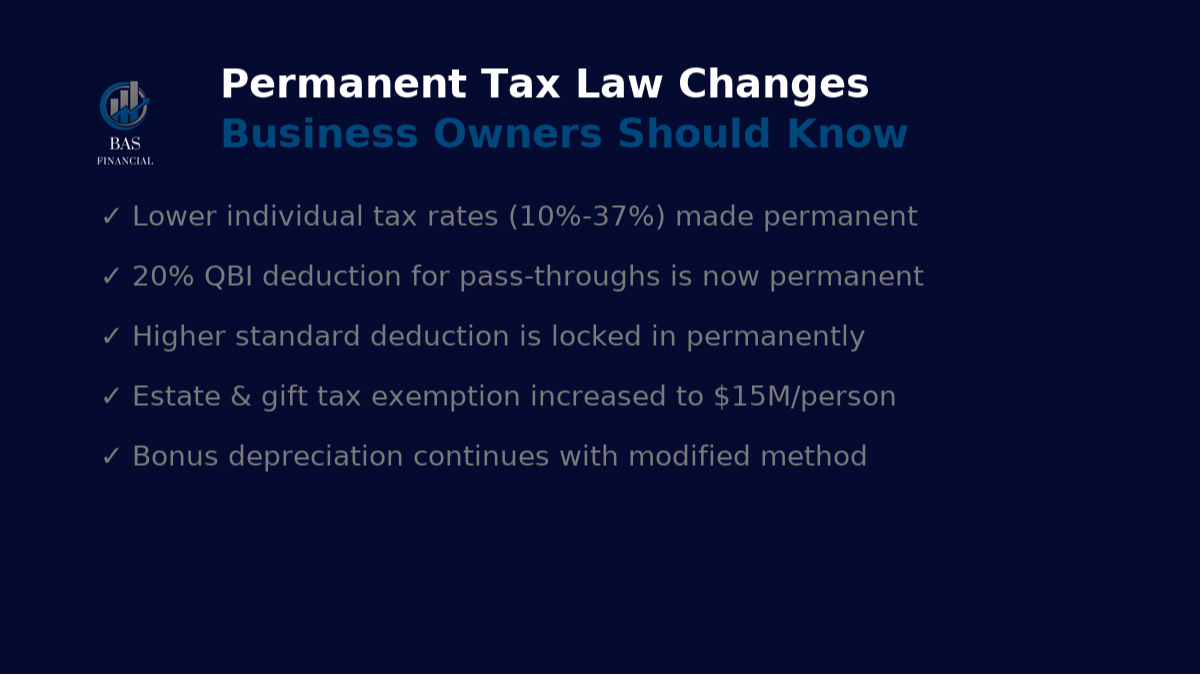
1. Lower Individual Income Tax Rates Are Here to Stay
The TCJA’s lower individual income tax brackets (10%, 12%, 22%, 24%, 32%, 35%, and 37%) were originally set to expire in 2025. OBBBA makes those rates permanent, removing the uncertainty around a possible return to the pre-TCJA brackets.
✅ Why this matters: If you’re a high-income earner or filing jointly with a spouse, locking in these lower rates allows for more strategic income planning, Roth conversions, and tax-efficient withdrawals.
2. The QBI Deduction Is No Longer Temporary
One of the most significant wins for small business owners under TCJA was the 20% Qualified Business Income (QBI) deduction (Section 199A) for pass-through entities like LLCs, S-corps, and sole proprietors.
Originally set to expire in 2025, the QBI deduction is now permanent under OBBBA.
✅ Why this matters: This deduction can effectively lower your taxable income by 20%, boosting cash flow and enabling reinvestment into your business. But the rules are complex, and maximizing the benefit depends on your income, industry, and how your business is structured.
If optimizing cash flow is a priority for you, don’t miss our guide:
👉 Navigating Cash Flow for Sustainable Growth
3. The Enhanced Standard Deduction Is Here to Stay
The higher standard deduction, another TCJA hallmark, has also been made permanent by OBBBA. In 2025, it will be indexed to inflation like other tax brackets.
✅ Why this matters: This simplifies filing for many households and makes itemizing less common—but if you live in a high-tax state or give substantially to charity, it’s important to review whether itemizing still works in your favor under the new law.
4. Estate and Gift Tax Exemption Gets a Boost
One of the most surprising changes under OBBBA: the estate and gift tax exemption will not only remain high—it will increase to $15 million per person in 2026, indexed for inflation.
✅ Why this matters: For business owners and families with generational wealth goals, this opens up planning opportunities using lifetime gifting, trusts, and business succession strategies. This is not a loophole—it’s a window, and it won’t stay open forever.
5. Bonus Depreciation Isn’t Going Away, but It’s Changing
The original 100% bonus depreciation allowed business owners to fully deduct the cost of qualifying equipment or property in the year it was placed in service. While bonus depreciation remains under OBBBA, it’s now calculated using a phased method that still offers substantial upfront deductions but with some limitations.
✅ Why this matters: If you’re planning major capital investments, timing those purchases and aligning them with your broader tax strategy will be critical.
Final Thoughts: Don’t Miss the Bigger Picture
The permanency of these provisions gives us a more stable playing field—but that doesn't mean your tax strategy should stay on autopilot. With inflation, economic uncertainty, and potential future legislation still on the horizon, now is the time to review your plan.
Business owners have unique opportunities to manage taxes, build wealth, and preserve it across generations. If you're not sure where to begin, I wrote more about this in:
👉 What the New Tax Law Means for You – A Financial Advisor’s Perspective
Ready to Make These Changes Work for You?
If you'd like to take a fresh look at your tax strategy, cash flow planning, or estate considerations, I’d be happy to help. You can schedule a complimentary consultation here.
Sources:
Contact Us
For personalized financial planning and asset management services, visit us at one of our convenient locations:
San Diego Office:
5405 Morehouse Drive, Suite 245
San Diego, CA 92121
Irvine Office:
2875 Michelle Dr, Suite 110
Irvine, CA 92606
To schedule a consultation, please call our office at (909) 307-4945 or email us at bradly_stevens@pacificadvisors.com. We look forward to helping you secure your financial future.
Guardian, its subsidiaries, agents and employees do not provide tax, legal, or accounting advice. Consult your tax, legal, or accounting professional regarding your individual situation. Tax laws are always subject to change. The information provided is based on our general understanding of the subject matter discussed and is for informational purposes only.