


If you're like many business owners I speak with, your mind is often on the numbers—top-line revenue, margin expansion, tax mitigation, and optimizing cash flow. And rightfully so. The financial health of your business matters, especially when you consider that 80–90% of your total net worth may be tied up in your company.
But here’s the truth that too many overlook: the greatest multiplier of business value isn't found on a spreadsheet—it’s embedded in your culture.
That multiplier is social capital, and if you want to build a business that’s not only profitable but sellable and transferable, it’s time to take it seriously.
What Is Social Capital, and Why Should You Care?
Social capital refers to the strength of your relationships, trust, shared values, and culture within your business. It’s what allows teams to function seamlessly, ideas to flow freely, and leadership to scale beyond one person.
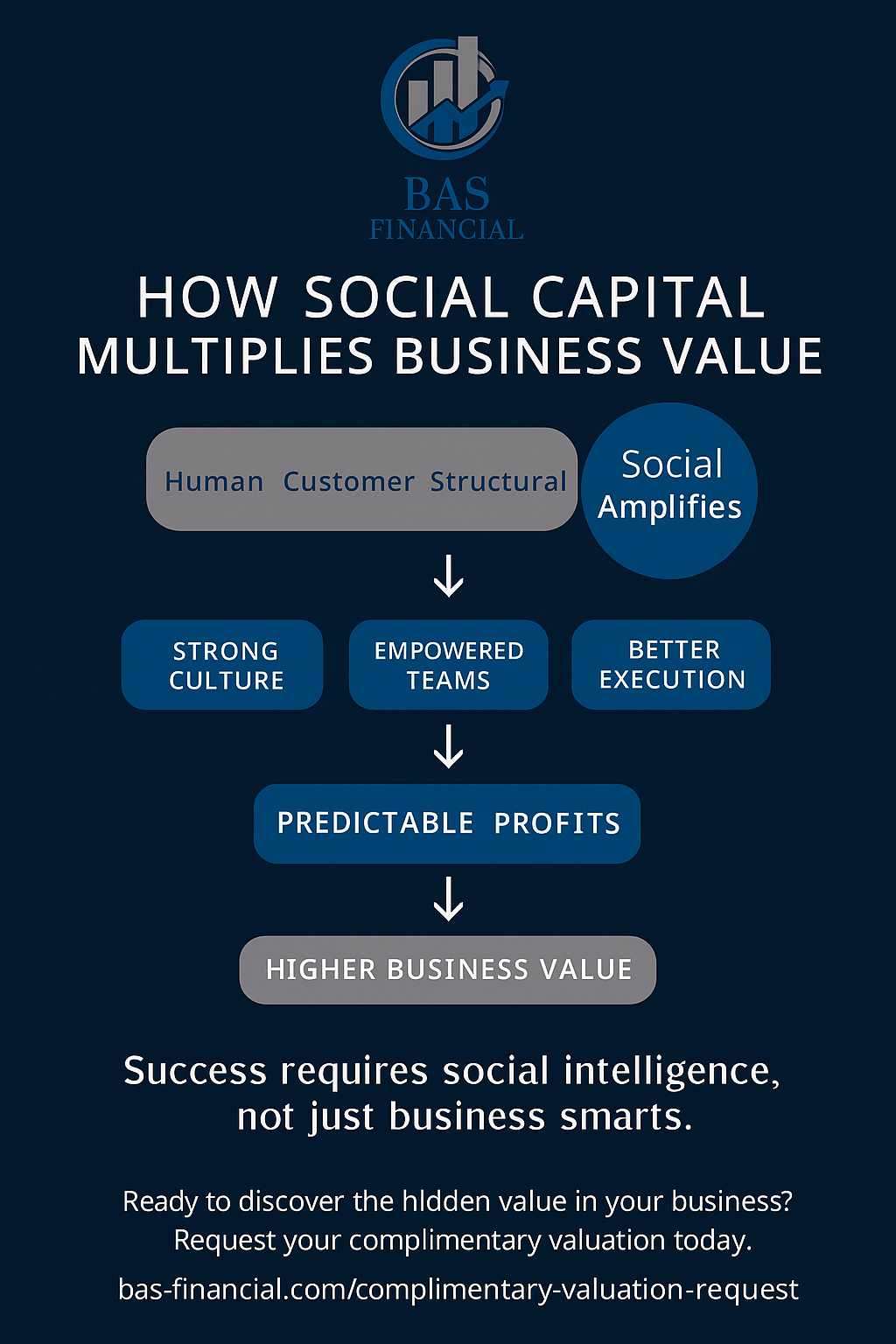
Unlike financial metrics or operational efficiencies, social capital is intangible—but its impact is measurable. As the Exit Planning Institute puts it in their article, The Greatest Predictor of Success, social capital is what optimizes the other three key intangibles in your business:
Human Capital – Attracting and retaining the right talent.
Customer Capital – Building loyalty and recurring revenue.
Structural Capital – Creating scalable systems and processes.
Without social capital, these pillars can crumble under pressure. With it, they become your competitive advantage.
The Real-World Value of Culture
Let’s be honest: we all know companies that “have the numbers” but seem chaotic on the inside—high turnover, siloed teams, and a founder who feels like they can never take a vacation.
Compare that with some best-in-class companies like Apple or Google. Their market dominance isn’t just about innovation—it’s about culture. They’ve created systems where shared mission and trust allow for consistent execution and long-term scalability.
In fact, studies show that companies with strong cultures see 4x higher revenue growth than those without one, according to Forbes. Employees at high-trust companies report 74% less stress and 50% higher productivity, according to Harvard Business Review.
And for business owners thinking about exit—buyers aren’t just purchasing your financials, they’re evaluating your people and processes. If your company only works because you are there, it’s not a sellable asset. But if your culture runs deep and your leadership is interdependent, you’ve built something truly transferable.
How Do You Know If You Have It?
That’s the big question—and one I help clients uncover every day.
Start by asking:
Is your team empowered to make decisions without your daily involvement?
Is your business attractive to employees and customers alike?
Are your values and expectations clearly documented and lived out?
Do people trust each other—and leadership?
These questions are part of a larger diagnostic I use with clients who request a complimentary business valuation. It’s not just about numbers—it’s about identifying what’s driving (or dragging down) your business value.
From Culture to Cash Flow
You might be thinking, “Okay Bradly, but I still need to improve profits today.” That’s fair. But here’s the connection: a strong culture enables consistent performance, which leads to more predictable cash flow. I recently wrote about this in Seven Cash Flow Drivers: The Path to Predictable Profits, where I explain how these drivers work together to create a resilient business model.
Culture supports execution, execution drives results, and results create value.
Take the Next Step
Whether you’re a few years from exit or just trying to build a more stable business today, don’t ignore the power of social capital. It might not show up in QuickBooks, but it shows up in the long-term value of your company.
Let’s talk about how you can identify, protect, and multiply the value of what you’ve built. Start by requesting a complimentary valuation, and we’ll begin the conversation with clarity and strategy.
—
External Sources:
Contact Us
For personalized financial planning and asset management services, visit us at one of our convenient locations:
San Diego Office:
5405 Morehouse Drive, Suite 245
San Diego, CA 92121
Irvine Office:
2875 Michelle Dr, Suite 110
Irvine, CA 92606
To schedule a consultation, please call our office at (909) 307-4945 or email us at bradly_stevens@pacificadvisors.com. We look forward to helping you secure your financial future.
Links to external sites are provided for your convenience in locating related information and services. Guardian, its subsidiaries, agents and employees expressly disclaim any responsibility for and do not maintain, control, recommend, or endorse third-party sites, organizations, products, or services and make no representation as to the completeness, suitability, or quality thereof.