


As business owners, we’re acutely aware that the economic landscape has shifted dramatically since the pandemic. While the labor market has loosened slightly, strong demand for quality talent remains—and employees now expect more than just a paycheck.
According to Willis Towers Watson, U.S. wages rose approximately 4.6% in 2023—the fastest in 15 years—as employers scrambled to retain staff amid stubborn inflation (IndeavorInvestopedia). Yet, higher pay alone doesn’t guarantee retention. McKinsey, Gallup, and Forbes tell a united story: total compensation today must include engaging benefits, flexibility, professional development, and a clear sense of purpose.
Here’s why this topic matters deeply to business owners:
Turnover is outrageously expensive. It can cost 50% to 200% of an employee’s salary to replace them—not just in recruiting, but also in training, lower morale, and lost productivity (Voltage Control).
Employees expect flexibility. Remote work, flex schedules, and well-being support are no longer optional—they’re table stakes (arXiv).
Retention builds competitive advantage. Firms with engaged, loyal teams are more agile, customer-focused, and profitable (SWBC PEO+13The Australian+13Doherty Staffing Solutions+13).
So let’s explore how business owners can craft a benefits and retention strategy that actually moves the needle.
1. Build a True “Total Rewards” Package
What it means
A total rewards strategy goes beyond salary. It includes benefits (like insurance and retirement), performance incentives, flexibility options, and non-monetary perks. According to Backstitch, offering transparency around reward structures fosters fairness and trust, giving employers an edge in the “war for talent” (Voltage Control+8PeopleKeep+8McConkey Insurance & Benefits+8backstitch.io).
Why it matters
Putting your full package—including health coverage, 401(k)/retirement match, PTO policy, and variable pay—on the table from day one can help:
Attract higher-quality candidates
Reduce turnover by building loyalty from the start
Level the playing field with larger companies that offer similar base pay
Action steps
Publish a one-page “Total Rewards Statement” for every role
Include variable pay like bonuses or profit-sharing tied to performance (Wikipedia+3Wikipedia+3Indeavor+3backstitch.io)
Clearly communicate perks like flexible work, education support, wellness stipends, and advanced role opportunities
2. Prioritize Flexible & Remote Work Options
Why flexibility matters now more than ever
Studies show that flexible work arrangements (FWAs) can help reduce turnover by up to 50% in some industries (Doherty Staffing Solutions+15Wikipedia+15McConkey Insurance & Benefits+15). Employees demand autonomy over when and where they work—remote options, flextime, or compressed work weeks.
Real-world examples
Chipotle reduced turnover from 164% → 131% by integrating career-path clarity, bonuses, and scheduling tech that offered shift predictability (WikipediaBusiness Insider).
Blue Loon Bakery improved retention by offering:
75% healthcare premium coverage
3% retirement match
Six weeks paid family leave
Even housing assistance (Business InsiderWikipedia+2Accurate+2Architectural Digest+2)
Action steps
Conduct a flexibility audit: remote friendly? flex schedules?
Pilot hybrid or compressed schedules
Invest in scheduling tools so employees feel trusted—not overworked
3. Invest in Professional Growth & Career Pathing
The retention power of growth
According to Indeavor, employees are far more likely to stay with an employer that offers training, mentorship, and upward mobility (Voltage Control+3Doherty Staffing Solutions+3Acacia Learning+3Indeavor).
Much of the turnover issue stems from:
Lack of career clarity
Feeling underutilized or stagnant
What works
Mentorship programs: match newer staff with senior employees
Cross-training or job rotations to refresh skills and knowledge
Clear promotion pathways with milestones and skills benchmarks
Tuition reimbursement, certifications, or conference opportunities
Action steps
Map realistic career ladders for all roles
Offer quarterly career check-ins
Budget for upskilling or education—especially tied to retention goals
4. Leverage Golden Handcuffs & Deferred Compensation
The concept
“Golden handcuffs” are incentives—like stock options, RSUs, or vesting bonuses—designed to keep employees through financial ties (Wikipedia). While often used in larger firms, small- and mid-sized businesses can leverage deferred or performance-based rewards that vest over time.
Why it can work
Creates a financial incentive to stay
Helps your retention alignment fit your cash flow or profit cycles
Action steps
Introduce vesting schedules for bonuses or profit-sharing
Consider phantom stock or deferred bonus systems
Make sure terms are clearly documented and legally sound
5. Build a Recognitive, Supportive Culture
Culture drives loyalty
Acknowledgement, respect, and cultural alignment often matter more than pay. Gallup notes that a “recognition-rich” culture can reduce voluntary turnover by 31% (Wikipedia+4SWBC PEO+4Wikipedia+4Wikipedia+12Wikipedia+12Architectural Digest+12Wikipedia). Meanwhile, WorkL research links happier staff directly to higher profitability(The Australian+1Architectural Digest+1).
What this looks like
Regular peer recognition programs—think shout-outs, digital badges
Quarterly or monthly “You Rock” awards for significant contributions
Company-wide listening sessions, culture check-ins, and transparent town halls
Action steps
Implement a simple recognition platform (e.g., weekly Slack kudos)
Train managers to give meaningful, timely feedback
Create a VMTO framework: Values → Mission → Targets → Outcomes to align all roles
6. Promote Holistic Well-Being
Why mental health matters
Mental well-being is no longer optional. Programs supporting stress reduction, meditation, and personal time off show ROI: IBM, Deloitte, and others have seen retention rise ~30% after launching mindfulness and EAP services .
How to start
Offer Employee Assistance Programs with free counseling
Provide wellness stipends, gym memberships, or meditation apps (Acacia Learning)
Replace “PTO days” with “well-being days” to reduce burnout stigma
Encourage healthy work–life integration with flex days, no-meeting blocks, etc.
Action steps
Launch a monthly mental health stipend
Educate and destigmatize mental health through internal comms
Celebrate visible “unplugged time”—e.g., leadership unplugging weekends
7. Measure & Iterate Retention Strategies
Why measurement matters
You can’t improve what you don’t measure. According to WorkL, leading employers use engagement data to predict turnover and intervene early (Accurate).
What to track
Turnover rate, voluntary exits, exit interview reasons
Employee Net Promoter Score (eNPS) every 6–12 months
Engagement survey themes: flexibility, recognition, well-being, growth
Action steps
Invest in basic tools (SurveyMonkey, Culture Amp, TinyPulse)
Share results transparently and track progress
Plug gaps with initiatives aligned with what employees actually care about
Case Study: Chipotle’s Multi‑Pronged Strategy
In May 2025, Business Insider reported that Chipotle and independent operators like Blue Loon Bakery saw significant retention gains by:
Career-path clarity: 85% of managers started as crew
Tech-enabled flexibility: AI-paced interview and shift scheduling tools
Transparent bonuses, tuition assistance, retirement—showing investment in staff as long-term employees (Business Insider+1Acacia Learning+1)
Result: Turnover rate dropped from 164% → 131% in two years—highlighting that structured benefits and culture signaling are both essential.
Putting It Together: Your 6‑Month Retention Roadmap
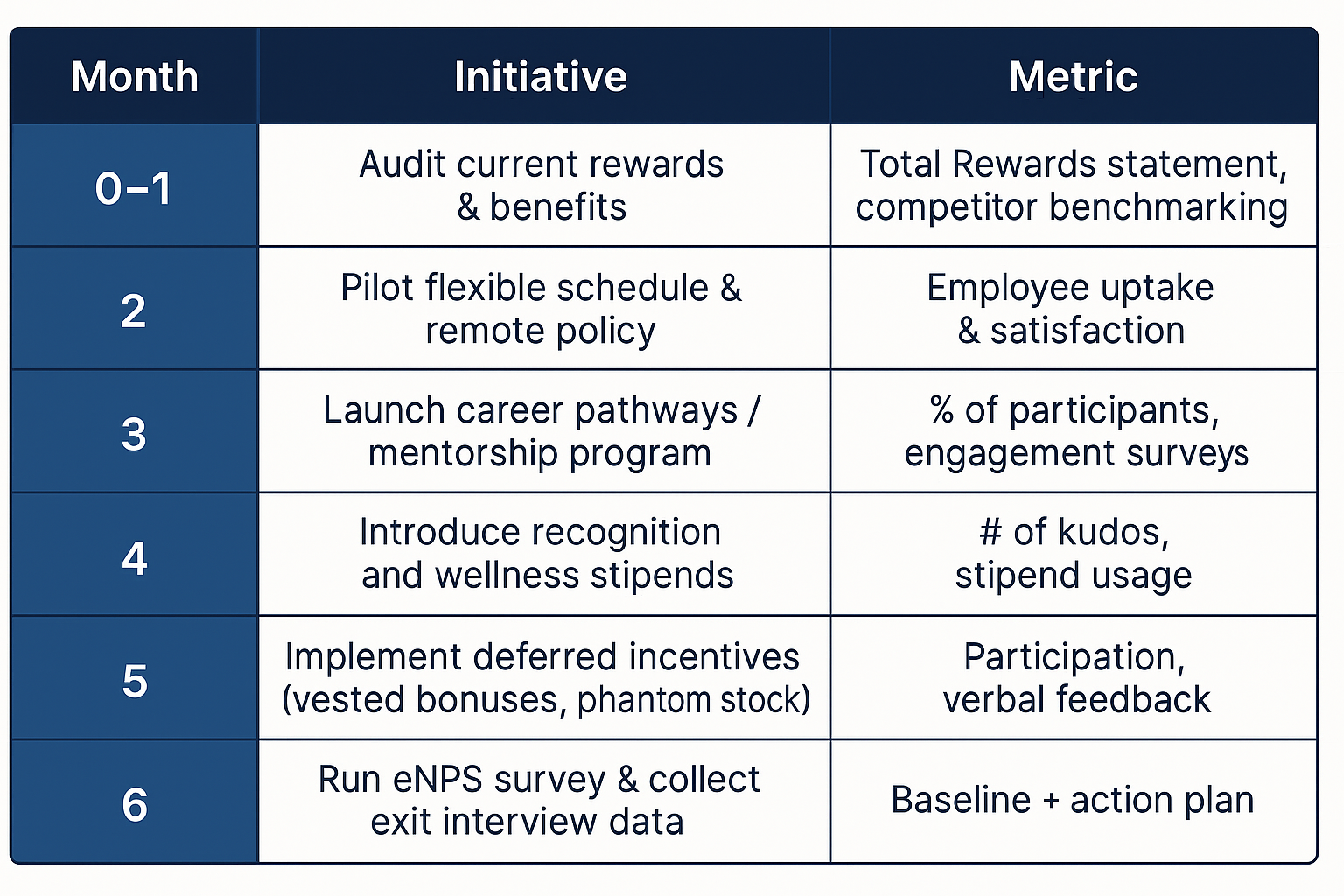
Final Word: Retention is a Competitive Asset
For business owners, retention isn’t a soft HR metric—it’s a key performance lever. Every invested dollar in benefits, well-being, and development returns multiple dollars in reduced turnover and increased productivity.
You don’t need a Fortune 500 budget. Start with clarity: communicate total rewards, offer flexibility, build growth paths, recognize contributions, support well-being—and continuously measure progress.
🔗 References
Willis Towers Watson on wage growth = fastest in 15 years—[Wage Surge 2023] (Business Insiderbackstitch.ioPeopleKeepInvestopedia)
Backstitch on transparency and total rewards = [Total Rewards Strategies](backstitch.io)
🔗 More Information
Read more in our “Planning for Business Succession” post here
Contact Us
For personalized financial planning and asset management services, visit us at one of our convenient locations:
San Diego Office:
5405 Morehouse Drive, Suite 245
San Diego, CA 92121
Irvine Office:
2875 Michelle Dr, Suite 110
Irvine, CA 92606
To schedule a consultation, please call our office at (909) 307-4945 or email us at bradly_stevens@pacificadvisors.com. We look forward to helping you secure your financial future.