


Retirement planning isn’t just about numbers—it’s about expectations, longevity, and making smart decisions long before the finish line. For professionals here in San Diego, these decisions are often amplified by our unique local economy and cost of living. In this post, we’re going deeper by focusing on seven additional retirement realities—tailored for the Southern California landscape—that directly influence how secure and fulfilling your future will be.
Whether you’re five years from retirement or just starting to plan, these insights will help you make smarter financial and lifestyle decisions.
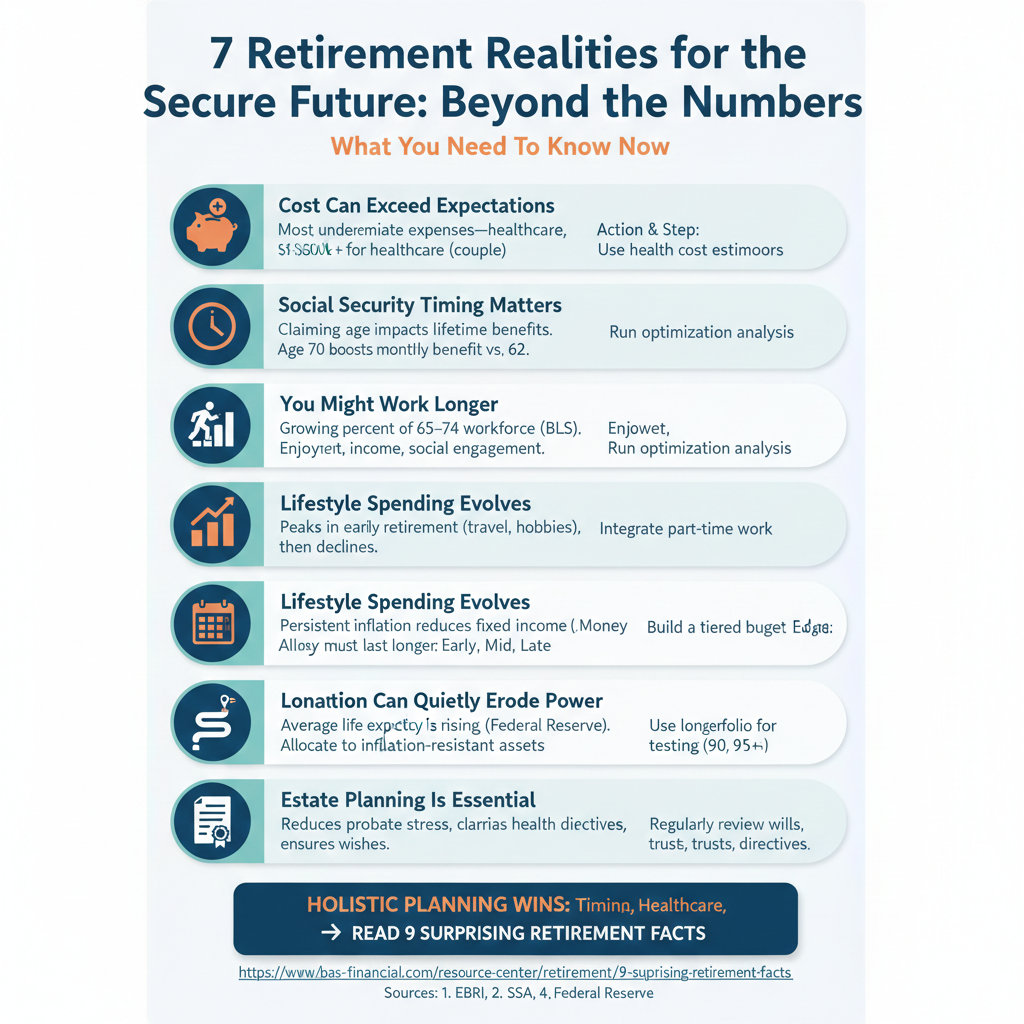
1. Retirement Can Cost More Than You Think
Most people underestimate how much money they’ll need in retirement — especially when factoring in healthcare and leisure.
A study by Employee Benefit Research Institute (EBRI) found that retired couples often need well over $300,000 just to cover healthcare not paid by Medicare.¹
Action Step: Use tools like health cost estimators and include potential extended care expenses in your planning spreadsheet. In high-cost areas like San Diego, these figures can be even more impactful when balancing premium local care with your desired lifestyle.
2. Social Security Timing Matters — A Lot
Your decision about when to claim Social Security can change your lifetime benefits by tens of thousands of dollars.
Staffing projections from the Social Security Administration show that waiting until age 70 to claim can boost your monthly benefit significantly compared to claiming at 62.²
This complements the insights from our “9 Surprising Retirement Facts” resource, which explains how many retirees rely on Social Security as a primary source of income — making timing a critical decision.
Action Step: Run a Social Security optimization analysis before making your claim.
3. You Might Work Longer — Voluntarily or Otherwise
Retirement today often looks different from the traditional “quit working at 65” model. According to the U.S. Bureau of Labor Statistics, a growing percent of people aged 65–74 remain in the workforce.³
This isn’t always a bad thing — many retirees continue working part-time because:
They enjoy the social engagement
They want to supplement income
They aren’t ready to leave the workplace entirely
4. Lifestyle Spending Patterns Change Over Time
As your daily routines shift in retirement, so will your spending. For many, spending peaks in the first 10 years of retirement — as travel, hobbies, and home improvements take center stage — then declines.
This aligns with some of the surprising patterns in the “9 Surprising Retirement Facts” page — particularly around retirement longevity and spending habits.
Action Step: Build a tiered retirement budget:
Early Retirement Years
Mid-Retirement
Late Retirement Years
This helps you more accurately forecast income needs.
5. Inflation Can Quietly Erode Purchasing Power
Even modest inflation can significantly reduce your retirement income’s effectiveness.
The Federal Reserve emphasizes that inflation has been higher and more persistent in recent years, which affects fixed incomes more than most retirees anticipate.⁴
Action Step: Consider how your portfolio and income sources can keep pace with inflation — this could mean allocating a portion of your portfolio to assets that historically outpace inflation.
6. Longevity Risk Is Real
Average life expectancy continues to rise. That’s great news — until you realize your money has to last longer than ever before.
Your “9 Surprising Retirement Facts” resource highlights longevity as a major factor: living longer increases your cumulative spending, healthcare costs, and the chances you’ll outlive your savings.
Planning Tip: Use longevity stress testing in your retirement projections — this shows how your plan holds up if you live to 90, 95, or beyond.
7. Estate Planning Isn’t Optional — It’s Essential
Far too many retirees forget about estate planning until it’s too late. A proper estate plan:
Reduces probate stress
Clarifies health care directives
Ensures wealth is passed to heirs according to your wishes
Tools like wills, trusts, and health directives should be reviewed regularly as your family and financial situation changes.
Summary: A Holistic View Wins the Day
Retirement planning isn’t just about setting a savings target — it’s about understanding a dynamic journey that involves budgeting, healthcare, taxes, legacy planning, and personal fulfillment.
Your retirement landscape will be shaped by:
✔ When you claim Social Security
✔ How you plan for inflation and healthcare
✔ Whether you continue working
✔ How long you live
✔ Whether you proactively plan your estate
If you haven’t yet read “9 Surprising Retirement Facts,” do so now — it pairs perfectly with the above retirement realities and will broaden your perspective even more.
👉 Read it here:
https://www.bas-financial.com/resource-center/retirement/9-surprising-retirement-facts
External Sources Referenced
Employee Benefit Research Institute (EBRI) – Retirement healthcare cost projections.
https://www.ebri.org/docs/default-source/rcs/2024/rcs_24-healthcosts.pdfSocial Security Administration – Claiming age and benefit amounts.
https://www.ssa.gov/planners/retire/agereduction.htmlU.S. Bureau of Labor Statistics – Labor force participation of older Americans.
https://www.bls.gov/news.release/pdf/empsit.pdfFederal Reserve – Inflation trends and their economic impact.
https://www.federalreserve.gov/monetarypolicy.htm
Contact Us
For personalized financial planning and asset management services, visit us at one of our convenient locations:
San Diego Office:
5405 Morehouse Drive, Suite 245
San Diego, CA 92121
Irvine Office:
2875 Michelle Dr, Suite 110
Irvine, CA 92606