
Article
Mega Backdoor Roth 2025: A Powerful Year-End Tax Strategy for High-Income Earners
Learn how high-income earners can use the Mega Backdoor Roth to boost tax-free retirement savings. Discover if it’s right for you, schedule a consultation today.
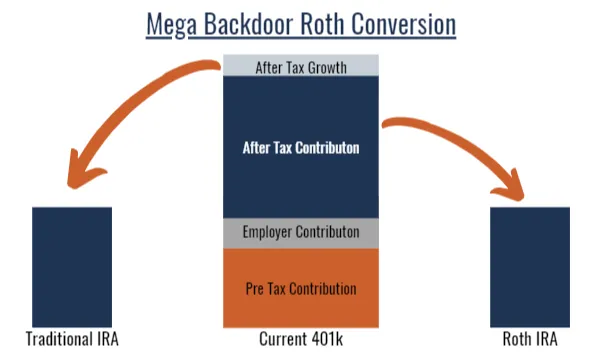
If you’re a high-income earner or professional nearing retirement, 2025 offers one of the last major opportunities to maximize tax-advantaged savings before possible changes to tax laws. One of the most effective, yet often overlooked, strategies is the Mega Backdoor Roth.
What Is the Mega Backdoor Roth?
The Mega Backdoor Roth allows you to contribute well beyond standard Roth IRA limits by making after-tax contributions to your 401(k) plan, then converting those funds into a Roth account.
Unlike a standard Roth IRA, this strategy lets you move tens of thousands of dollars into a income tax-free growth vehicle, if your employer plan allows both after-tax contributions and in-plan Roth conversions or in-service rollovers to a Roth IRA.
For 2025:
- Employee contribution limit: $23,500 (plus $7,500 catch-up for age 50+)
- Total 401(k) limit (employee + employer + after-tax): $70,000 (or $77,500 if age 50+)
(Source: Fidelity)
Why It may be Valuable in 2025
With future tax changes on the horizon, the Mega Backdoor Roth helps you:
- The potential to grow more income tax-free assets for retirement.
- Reduce long-term tax exposure in higher-income years.
- Avoid RMDs (required minimum distributions) on Roth IRA assets.
- Increase estate efficiency, as Roth accounts can be passed on income-tax-free.
It’s an especially powerful move when paired with other year-end strategies like:
- Tax-loss harvesting to offset gains (BlackRock)
- Using the current high gift and estate tax exemption before it potentially sunsets (Mercer Advisors)
Plan designs differ on how much room there is. Southern California Permanente Medical Group’s 401(k) Plan for Permanente Medical Groups, for example, accepts traditional after-tax contributions and in-plan Roth rollovers, but those contributions share one annual limit with the SCPMG Keogh Plan, which we walk through in the SCPMG Keogh and 401(k) guide.
Is It Appropriate for You?
You may benefit from the Mega Backdoor Roth if:
✅ You’re already maxing out standard 401(k) and IRA contributions.
✅ You have excess cash flow to invest for long-term growth.
✅ Your 401(k) allows after-tax contributions and Roth conversions.
If not, consider a Backdoor Roth IRA, or explore tax-loss harvesting and strategic gifting to optimize your 2025 tax position.
Take Action Before Year-End
For high-income earners, the window to leverage the Mega Backdoor Roth and other powerful tax strategies may be closing. Don’t leave these opportunities on the table, review your options now.
📅 Get a clear read on where you stand and see how these strategies fit your financial plan.
Sources:
- Fidelity: What Is a Mega Backdoor Roth?
- Mercer Advisors: Making a Backdoor or Mega Backdoor Roth Contribution in 2025
- BlackRock: Tax-Loss Harvesting Strategies
Contact Us Based in San Diego. Working with clients nationwide. Call (858) 384-3533 or email BStevens@BAS-Financial.com
To schedule a consultation, call (858) 384-3533 or email BStevens@BAS-Financial.com. We look forward to helping you secure your financial future.
This material does not constitute tax, legal, or accounting advice. Consult your tax, legal, or accounting professional regarding your individual situation. Tax laws are always subject to change.
Talk this through
If any of the above applies to your situation, the next step is a conversation about your specific numbers rather than the general case.
Book my intro callA 30-minute call. No document gathering beforehand, and no obligation afterwards.