
Article
The Four Intangible Capitals of Business
Ready to unlock the full potential of your business? Assess your intangible capitals today.
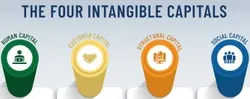
TL;DR: What are the four intangible assets?
The four intangible assets (also called intangible capitals) of a business are:
- Human Capital, the skills, experience, and motivation of your people
- Customer Capital, the strength and longevity of customer relationships
- Social Capital, company culture, values, and community reputation
- Structural Capital, documented processes, systems, and intellectual property
These four intangible assets play a critical role in determining a company’s long‑term value, stability, and transferability.
As a financial advisor, I often emphasize the importance of tangible assets like property, equipment, and inventory when evaluating a company’s value. However, there’s another critical aspect that often gets overlooked: intangible assets. These intangible assets, often referred to as “capital,” can significantly impact a company’s overall worth and future potential.
For many business owners, these intangible drivers are also central to how a business becomes more transferable, scalable, and ultimately more valuable over time. If you want to see how these concepts fit into a broader framework, you can explore the
San Diego Business Owner Blueprint
, which outlines how business, personal, and financial decisions all connect.
Today, I want to discuss the four intangible capitals that every business should focus on: Human Capital, Customer Capital, Social Capital, and Structural Capital.
Human Capital: The Heart of Your Business
Human Capital is essentially the value of the talent you have within your company. It’s about the collective skills, experience, and motivation of your team. A strong mix of talent, experience, resilience, and motivation can significantly increase your company’s value. All things being equal, the stronger your human capital, the more the market will value your company.
Key considerations for Human Capital:
-
Recruiting the right talent:
Identify the specific characteristics you’re looking for in a key employee and ensure your hiring process aligns with these criteria.
-
Motivating and retaining employees:
Create a positive work environment that encourages and appreciates your current employees. Offer competitive compensation, opportunities for professional development, and recognize their contributions.
-
Evolving with your team:
As your business grows, ensure your current team has room to advance through promotions and development opportunities. This helps retain top talent and fosters a sense of growth within the company.
Customer Capital: The Strength of Your Relationships
Customer Capital measures the strength of your relationships with your best customers. Deep, integrated, and long-term relationships, recurring revenue, contractual relationships, and a diversified customer base all contribute to strong customer capital.
Key considerations for Customer Capital:
-
Relationship depth and longevity:
Focus on building deep and long-term relationships with your customers. Understand their needs, anticipate their future requirements, and become an integral part of their success.
-
Recurring revenue and contracts:
Aim for recurring revenue streams and consider contractual relationships to provide a more predictable and stable income flow.
-
Customer segmentation and analysis:
Regularly analyze profitability by customer and product to identify your most valuable customers and tailor your offerings and strategies accordingly.
Social Capital: Company Culture and Community
Social Capital, or company culture, is the intangible asset that embraces the people. It’s what elevates a company to be best in class as it optimizes the other three capitals. How your company communicates, what it believes in, and how it operates internally and externally are key components of its culture. It’s also reflected in your company’s contributions to the community.
Key considerations for Social Capital:
-
Defining your culture:
Clearly articulate your company’s values, mission, and vision. Ensure that these values are lived by all employees and are reflected in your day-to-day operations.
-
Employee engagement and satisfaction:
Foster a positive and inclusive work environment where employees feel valued, motivated, and engaged.
-
Community involvement:
Give back to your community through charitable initiatives, volunteer work, or other social responsibility programs.
Structural Capital: The Foundation of Your Business
Structural Capital refers to the backend infrastructure of your company, such as your processes, financials, strategies, information technology, patents, and other intellectual property (IP). It’s the documented know-how and know-what of the company that positions you for speed and flexibility. Structural Capital connects people to knowledge, enabling it to be shared and scaled across the business.
Key considerations for Structural Capital:
-
Documented processes:
Ensure your key company processes are well-documented and transferable to new employees or situations.
-
Financial optimization:
Develop a strategy to optimize your capital and financial structure, including debt management, cash flow management, and investment decisions.
-
Infrastructure efficiency:
Regularly assess the utilization of your equipment and facilities to identify opportunities for improvement and cost savings.
By focusing on these four intangible capitals, you can significantly enhance your company’s value and position it for long-term success. Remember, these capitals are interconnected and interdependent. Building a strong foundation in one area will positively impact the others. You can access an info graphic on this subject here Info Graphic: Four Intangible Capitals.
If you are interested in discussing maximizing your intangible capital or the three doors you can walk through when exiting your business schedule a complimentary consultation today: Get a clear read on where you stand.
Contact Us Based in San Diego. Working with clients nationwide. Call (858) 384-3533 or email BStevens@BAS-Financial.com
📞 Phone: (858) 384‑3533
If you’d like to start with a conversation about your situation, goals, and whether working together makes sense, you’re welcome to reach out.
Talk this through
If any of the above applies to your situation, the next step is a conversation about your specific numbers rather than the general case.
Book my intro callA 30-minute call. No document gathering beforehand, and no obligation afterwards.